Manufacturing
Overview
The manufacturing industry is the biggest industry in the world when it comes to the revenue generated and people employed. Manufacturing is directly related to the growth of a country’s economy. The vast repositories of data and the large amount of revenue generated by these industries make it highly susceptible to cyberattacks. According to the United States Department of Homeland Security, the manufacturing industry is the second most targeted industry.
There exists a common perception among the small business community that smaller organisations are too small to be attacked by hackers. However, facts suggest that smaller businesses should be extra vigilant as hackers tend to attack companies with weaker cybersecurity systems in place. Moreover, small manufacturing units are frequently attacked to gain entry into the larger manufacturing chains.
A big chunk of the attacks on the manufacturing industry uses emails as an attack vector. Hence, it is of utmost importance that email communications within the industry are secure and capable of warding off cyberattacks.
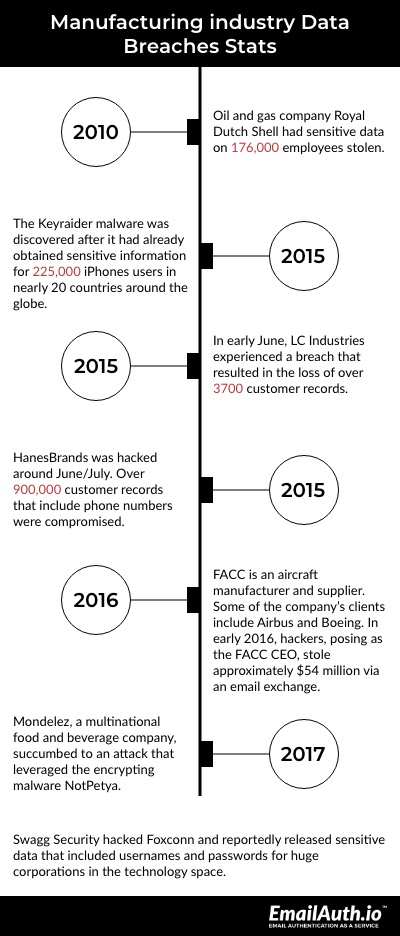
Manufacturing industry Data Breaches Stats
- Early June 2015, LC Industries experienced a breach that resulted in the loss of over 3700 customer records.
- FACC is an aircraft manufacturer and supplier. Some of the company’s clients include Airbus and Boeing. In early 2016, hackers, posing as the FACC CEO, stole approximately $54 million via an email exchange.
- HanesBrands was hacked around June/July of 2015. Over 900,000 customer records including phone numbers were compromised.
- Swagg Security hacked Foxconn and reportedly released sensitive data that included usernames and passwords for huge corporations in the technology space.
- In 2010, oil and gas company Royal Dutch Shell had its sensitive data on 176,000 employees stolen.
- In 2015, the “Keyraider” malware was discovered after it had already obtained sensitive information for 225,000 iPhone users in nearly 20 countries around the globe.
- In 2017, Mondelez, a multinational food and beverage company, succumbed to an attack that leveraged the encrypting malware NotPetya.
How Can DMARC Help?
DMARC (Domain-Based Message Authentication, Reporting, and Conformance) is an email authentication standard or protocol that determines whether an email is authentic or not. It relies on SPF and DKIM, two other protocols, to decide the authentication status of an email
For detailed information, read more on What is DMARC?
The manufacturing industry follows a chain system where every cog is important. What keeps this wheel going is effective and secure communication between every channel. Most of the communication takes place via emails and this makes it a potential target for cybercriminals.
CEO Fraud, ATO attacks, and phishing attacks are just a few threats to the manufacturing industry. But there is a way out: DMARC. Implementing DMARC ensures that the industry isn’t harmed by spoofing or phishing since it provides visibility of an email’s original source and not the source it claims to be from.
An email sender trying to impersonate a reputed manufacturing firm will be blocked if the recipient has DMARC already implemented. It is the only effective solution to ensure that all employees, business partners, supply chains, or other end recipients involved in the manufacturing sector in some form or another do not get spoofed by a malicious attacker.
You can set up DMARC on your domain using EmailAuth’s DMARC Record Generator. The EmailAuth dashboard completely automates the DMARC setup process, making it easier to choose who is allowed to send emails on your domain’s behalf and keep track of your enforcement policies. To monitor and verify your DMARC records, use EmailAuth’s DMARC Record Checker.
Apart from providing companies and organizations with email security and complete control of their email domains via DMARC, EmaiAuth has other added advantages. Head to Benefits of DMARC to read more about them.