FMCG (Fast-Moving Consumer Goods industry)
Overview
The FMCG or the Fast-Moving Consumer Goods industry is among the fastest-growing around the world. Fast-moving consumer goods may include, but is not limited to, packaged food, toiletries, beverages, office supplies, over-the-counter medicines, detergents and washing powders, and plastics.
Given the humongous size of the industry, it becomes imperative that proper and protected channels of communication be used. Emails are an integral and probably the biggest channel of communication in the FMCG industry. However, with easy accessibility comes bigger risks. Emails are susceptible to cyberattacks that can lead to companies losing millions of dollars in finances and customer data.
Thus, it is necessary that every cog in the wheel that is the FMCG industry is safe and secure. DMARC compliant emailing systems save the company from impending cyberattacks and loss of money and data.
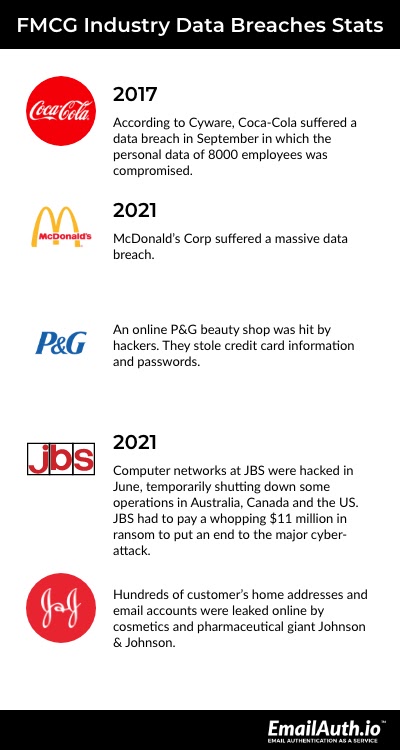
FMCG Industry Data Breaches Stats
- According to Cyware, Coca-Cola suffered a data breach in September 2017 in which the personal data of 8,000 employees was compromised.
- McDonald’s Corp suffered a massive data breach in 2021.
- An online P&G beauty shop was hit by hackers, who stole credit card information and passwords.
- Computer networks at JBS were hacked in June 2021, temporarily shutting down some operations in Australia, Canada, and the US. JBS had to pay a whopping $11m (£7.8m) in ransom to put an end to the major cyberattack.
- Hundreds of customers’ home addresses and email accounts were leaked online by cosmetics and pharmaceutical giant Johnson & Johnson.
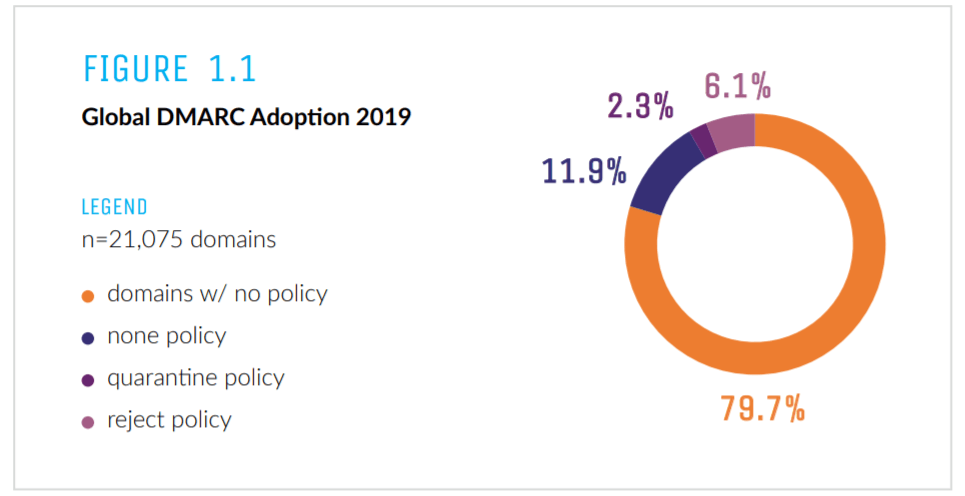
FMCG Industry DMARC Adoption
A global DMARC adoption report revealed that almost 80% of companies in the FMCG industry had left their consumer data vulnerable and open to attacks.
How Can DMARC Help?
DMARC (Domain-Based Message Authentication, Reporting, and Conformance) is an email authentication standard or protocol that determines whether an email is authentic or not. It relies on SPF and DKIM, two other protocols, to decide the authentication status of an email.
For detailed information, read more on What is DMARC?
DMARC is of utmost importance to the FMCG industry since it has a large number of emails being sent and received daily. The industry operates on a humongous scale, which makes it a breeding ground for potential loopholes in their communication channels.
Cyber attackers may use this opportunity to rob the industry of sensitive data and money. Implementing DMARC ensures that the industry isn’t harmed by spoofing, phishing, or impersonation since it provides visibility of an email’s original source and not the source it claims to be from.
An email sender trying to impersonate your reputed brand will be immediately rejected if the recipient has DMARC already implemented on their DNS. It is the only effective solution to ensuring that employees, business partners, supply chains, or other end recipients in the FMCG industry do not get spoofed by an attacker using your domain.
You can set up DMARC on your domain using EmailAuth’s DMARC Record Generator. The EmailAuth dashboard completely automates the DMARC setup process, making it easier to choose who is allowed to send emails on your domain’s behalf and keep track of your enforcement policies. To monitor and verify your DMARC records, use EmailAuth’s DMARC Record Checker.
Apart from providing companies and organizations with email security and complete control of their email domains via DMARC, EmaiAuth has other added advantages. Head to Benefits of DMARC to read more about them.